
4 research-based tools to help you build a strong, resilient family in 2026
Here’s what kids tell us they want from parents when life gets busy.


This newsletter is available to Paid subscribers and Parenting Toolbox School Members. Please note that School Members are authorised by Copyright Permission to distribute it within their school community. We will send your linked graphics and texts shortly.
Please note: Enrolment for new Paid Members and new Parenting Toolbox School members for 2026 will CLOSE on 28th February.
Feeling time-poor?
Got too many things on the go?
Never seem to be able to make time for your partner or kids?
If you nodded your head to any of these questions, then you’re not alone.
Lack of time and competing priorities have long prevented parents from being the kind of parents we all aim to be.
But there’s a solution…..and it’s not Quality Time.
My research into busy working parents revealed four key strategies for building a strong, happy, and healthy family.
Let’s explore these four tools together and discover how you can apply them to your family.
Tool # 1: One-on-One Time
The best way to build relationships with kids is to spend time with them.
I’m not talking about grand gestures such as going to the movies, although, as I’ll mention further on, that has its part.
Rather, the ordinary, everyday interactions you have with kids are key to relationship-building.
In my work with Australian children, I heard repeated stories about the simple times they spend with a parent doing every day stuff.
Getting breakfast.
Playing a game.
Watching a program together online or on TV.
Going for a walk.
It was always the everyday, low or no-cost activities they enjoyed one-on-one with a parent. Not with the whole gang.
Don’t let your partner explain your kids to you
Some parents have relationships with their kids vicariously through their partners- who spend a great deal of their time explaining the kids to them (“You know, Benny had a bad day at school today….”) and vice versa (“Your father is very busy at the moment”).
That’s not how relationships work.
Some parents are permanently separated from their kids due to work or other circumstances, which is incredibly tough.
If this is you, then make the most of the time you are together. Look for opportunities to spend time with each child individually.
Establish personal rituals that link you with each child, even when you’re not around. (More about this below)
Remember middle children
The research shows that eldest children and youngest children receive more one-on-one time with parents than middle children.
You may need to intentionally ask middle children to accompany you to the supermarket, or invite them to play a game with you.
Don’t leave bonding to chance.
Expert tips for One-on-One Time
Choose the same place: Recall a place or space where you experience successful connections with your child. You will have one. It may be a chair, a couch or a play space outside. Return to this place when you want to talk or feel at peace with your child.
Understand their connection preferences: Dr. Gary Chapman's work on love languages is profound. My three kids prefer to connect in different ways, and understanding this has been a real bonus. One enjoys chatting, another loves doing activities together, and the third responds to acts of service. Aligning with their love languages makes bonding easier.
Do things you enjoy with your child: Two reasons for this. First, when you share your passions, things you love or the activities you want, you are more likely to loosen up, relax and show your human side. Second, kids love it when you share something of yourself with them. It builds their sense of belonging and deepens their connection to you.
Tool # 2: Family Rituals
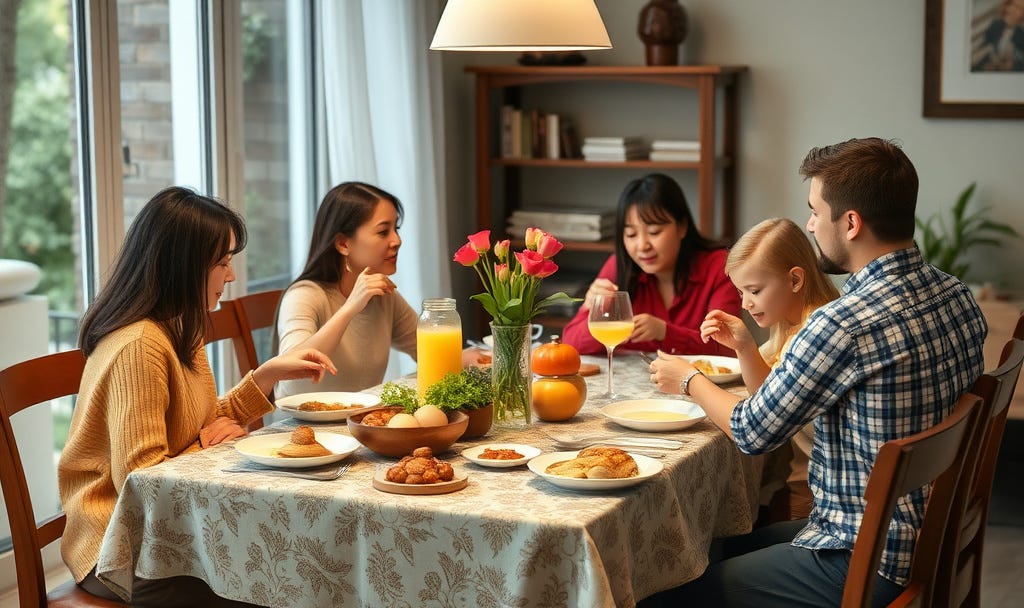
Rituals bind families together.
Without them, families inevitably break down.
Popular Australian Parenting educator Maggie Dent says, “Family rituals are positive, which strengthen the sense of warm connectedness in families. This makes sense, given that the number one biological need for every human is the hunger to belong, and to be accepted, valued and loved.”
So what makes a family ritual?
It’s anything that brings a family together regularly, whether to celebrate something special, such as a birthday, or other celebrations.
Make rituals your own
My family has developed its own set of rituals, including how we celebrate birthdays - yep, they are weird, noisy, with a silly version of the Happy Birthday song, and we also celebrate Christmas and other times of the year.
Regular mealtimes are the most critical ritual your family can have. There’s a high correlation between families that eat together at least five times a week and good mental health in teenagers.
This is presumably because parents can monitor their teens’ mental health more easily in this setting.
So when life is busy and catching up with everyone is hard, it’s the simple family rituals you’ve put in place that pull you all together.
Your rituals are the super-glue that bonds you together into a tight family unit.
Expert tips for family rituals
Establish negotiables and non-negotiables: Work with children to determine which rituals they must attend and which they can miss. This is important for teenagers, whose social and school lives are increasingly busy. For instance, being home for a sibling’s birthday is non-negotiable; however, attending an aunt’s birthday may be negotiable.
Be flexible: Adapt your rituals to suit your family’s lifestyle. For instance, for many years I spoke to parents in schools and the community up to three nights a week, which made shared evening mealtimes with my family difficult. Our solution was to “do” mealtimes at breakfast. Slow and leisurely…..to a point…was the go. They were more than a fuel stop, as most breakfasts seem to be.
Make sure they happen: One thing stood out in my research into family rituals - they rarely occurred by accident. It usually took a parent—usually a mother—to ensure they happened and that everyone showed up.
Tool # 3: Personal Rituals
What interactions with you do your kids look forward to? Which interactions can they rely on?
Is it a Saturday morning walk? An evening bedtime story? Watching a game of sport together each week?
While one-on-one time is generally random, built on the bedrock of good intentions, personal rituals are set in stone. By their nature, they always happen.
Kids can rely on them. That’s their magic.
They bring predictability to your relationships. They show you are reliable. They help build their sense of security and safety.
Expert tips for personal rituals
1. Turn routines into rituals: Bedtime routines that include reading to children or singing special bedtime songs or even just lying beside your child do far more than help your child fall asleep. When these routines are repeated, they create neural pathways that enhance loving connection.
As a grandparent, I always made sure I was the one who bathed my grandkids when they were little, as it was the only chance I had to spend time with them alone. I was the ‘bathguy’ whenever they stayed over on visits. (Explanation: two of my kids live a long way from us, so they inevitably stay over on family visits.)
2. Make them special: If one-on-one is grounded in the everyday, personal rituals can be special events. A date with a teenager once a month, an ice cream with a young child each weekend, a special birthday movie once a year - are examples of special rituals that both you and your children will long remember.
3. Create greeting rituals: Welcoming and farewelling rituals for each child is essential. How you welcome and reconnect with children after a day away shows them that you have missed them and still love them.
With young children, leave a kiss on their palm. For others, there are special handshakes and or that oldie (but a goldie) “See you later alligator” to which they naturally reply, “in a while, crocodile.”
Tool # 4: Downtime
Pacific Islander cultures (e.g. Samoan, Tongan, Maori) are renowned for their strong family ties.
One feature they share is spending a great deal of time together, including extended family members. They don’t just gather for celebrations or special events; they go about their everyday lives, enjoying each other’s company.
My research on busy families found that close families in Western countries shared one factor that enabled the type of closeness evident in Pacific Islander families. They enjoyed downtime (also known as Mooch time) together.
Families who enjoyed some downtime together on a regular basis appeared happier and more tolerant of each other. They had closer ties, shared mutual interests and generally enjoyed each other’s company.
Downtime is the period spent together when little is happening. Family members are going about their lives, and interactions feel natural rather than contrived.
Lazy Sundays, easy evenings, do-nothing-much holidays here we come!!!
Expert tips for down-time:
Recognise its importance: Doing nothing can seem like a luxury, particularly when there are jobs to be done, or work is calling you. But regular time in the evening or at weekends, where nothing productive seems to be done, is good for your mental health and a boon for family relationships.
Guard it: Don’t be afraid to make a call on a child’s second/third organised activity for a day that takes you and/or them away from some downtime. Families in perpetual motion can easily grind to a halt and need someone to keep the guardrails up.
Organise it: If all else fails, call time on everyone being off in every direction and organise a family weekend away every so often so people can chill and enjoy each other’s company. The best parenting is intentional rather than accidental when it comes to building strong family bonds in this current era.
Putting It Into Practice
Okay, time get practical and create some change - if that’s what’s needed. Revisit the 4 tools above and answer these three questions:
1. What’s working?
Which of these tools is working for you at the moment? It may help to rank them by effectiveness.
2. What’s not working?
Which tools are either not in place or are not working for you? What are the barriers to success?
3. What will you work on?
Choose one tool to work on. Make it a focus of your attention over the next fortnight. Make a plan to put that tool into action. Plan how to handle any barriers.
Make a start
The most important part of forming a new habit is starting! If you want to start establishing family mealtimes, then start with one a week. Make it non-negotiable.
Start small. Experience success.
Repeat.
Then repeat and expand.
Now get cracking! You’ve important work to do.
Let me know how you went.
I’d love to hear your thoughts, comments or questions.